The Deadstock Dilemma: What Sustainable Fabric Really Costs Your Production Plan
January 29, 2026
A wholesale business expanding into retail reached out with a specific plan: buy deadstock fabric in LA and create styles directly for their stores. The concept was solid, the sustainability angle was genuine, and the cost savings on materials looked attractive. What they hadn’t accounted for was how fundamentally deadstock changes every other part of production.
Another founder wanted to produce a dress and jacket from deadstock, requesting samples only in small, medium, and large to start. That size range wasn’t a business decision. It was a material constraint. They had limited yardage and couldn’t risk developing a full size run until they knew exactly how much fabric each garment would consume.
Deadstock and upcycled materials appeal to founders for good reasons: lower material costs, genuine sustainability credentials, and unique fabric that competitors can’t easily replicate. What most don’t realize until they’re mid-development is that when you can’t reorder fabric, everything about how you manufacture has to change.
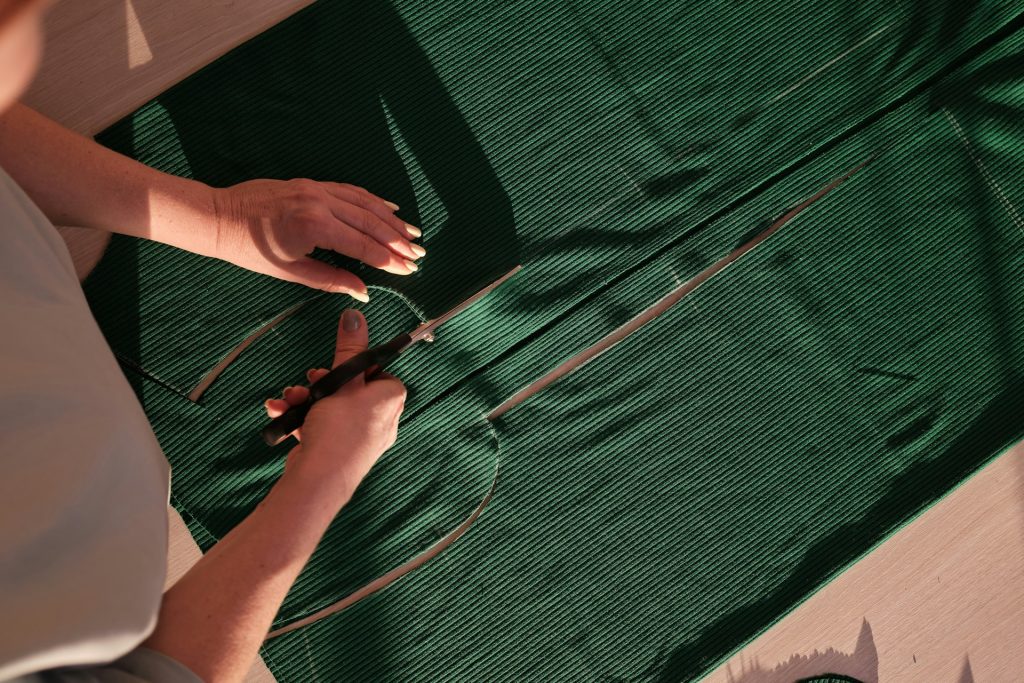
What Is Deadstock Fabric?
Deadstock fabric is unused material that never made it into production. This includes overruns from large manufacturers, end-of-roll remnants from fabric mills, cancelled orders, or discontinued colorways and prints. It’s typically sold at deep discounts because it’s taking up warehouse space and won’t be produced again.
Upcycled materials are different but create similar constraints: surplus military blankets, vintage textiles, or reclaimed materials repurposed into new garments. Both categories share the same fundamental limitation: finite supply with no reorder option.
Why “You Can’t Reorder” Changes Everything
Standard production operates on the assumption that if a fabric works, you can get more of it. You develop your patterns, approve your samples, place your production order, and if the style sells well, you reorder fabric and produce again. That predictability is what makes scaling possible.
Sustainable fabric sourcing from deadstock operates differently. You’re working with a finite quantity. Whatever yardage exists is the total universe of what you can produce, ever, in that style. This constraint ripples through every stage of development and production in ways that aren’t immediately obvious.
- Pattern development becomes a yield optimization problem. Standard pattern making prioritizes fit and construction. Deadstock pattern making adds a third priority: fabric efficiency. Every inch of wasted material in your pattern layout is inventory you can’t recover. If your pattern wastes 15% of each yard through inefficient layout, that’s 15% fewer garments you can produce from your available stock.
- Sampling becomes expensive in a new way. A normal sample might consume two yards of fabric. If you have 50 yards total, that’s 4% of your entire inventory gone before you’ve sold a single piece. Multiple sample rounds, fit adjustments, or style iterations eat through irreplaceable material. Founders working with deadstock often find themselves trying to approve samples faster than they should, or limiting revisions, because every version costs them production capacity.
- Size grading may not be possible across your full range. Standard production scales across sizes because you can order more fabric if demand skews large or small. With deadstock, you’re pre-committing to a size distribution based on yield calculations before you have any sales data. That dress and jacket founder requesting only S/M/L samples wasn’t planning a limited size range by choice. They were planning around the reality that they might not have enough fabric for a full XS through XL run.
- Production quantities are dictated by yardage, not demand. In normal production, you decide how many units to make based on projected sales, cash flow, and minimum order quantities. With deadstock, you make as many as your fabric allows and hope demand matches supply. The military surplus outerwear brand wasn’t deciding between 100 or 200 units per style. They were calculating how many jackets they could physically extract from their available field blankets.
The Hidden Development Costs
Material savings from deadstock often get offset by increased development costs that founders don’t budget for.
Testing and sampling become more complex because you need to verify yield before committing to full production. Professional fabric cutting and layout matters more when material is irreplaceable. A cutting error in standard production is annoying. In deadstock production, it can eliminate an entire size from your range or reduce your production run by 20%.
You may need multiple pattern iterations to maximize yield without compromising fit. A pattern maker working with deadstock will often create two or three layout variations to find the configuration that extracts the most garments from available yardage. That’s additional pattern work you wouldn’t need with reorderable fabric.
Grading becomes more strategic. Rather than grading a full size range and producing evenly across sizes, you’re making calculated decisions about which sizes to offer based on material constraints. Do you produce XS through XL with fewer units per size, or S through L with more depth per size? The answer depends on your customer data, but you’re making that call with less flexibility than a standard production run would allow.
What Happens When You Run Out
This is the question most founders don’t ask until it’s too late: what’s your plan when you sell through your deadstock inventory?
Here are some options you might consider:
- You discontinue the style entirely. This is honest and works if the deadstock fabric was central to the style’s identity. You can’t replicate it, so the style was inherently limited edition. Customers understand this if you’ve communicated it upfront.
- You find a similar fabric and hope customers don’t notice. This rarely works as well as founders hope. Even if you source a visually similar fabric, hand feel, drape, and performance characteristics almost never match perfectly. Customers who bought version one will notice version two is different, and some will be vocal about it.
- You redesign the style for new fabric. This is more honest than substitution but requires essentially starting over with pattern development and sampling. The style they loved in your deadstock version may not work the same way in a different material.
- You accept that this was a one-time product. Many successful deadstock projects treat each fabric find as its own capsule. The military surplus brand’s field blanket jacket might sell out and never return, but their next drop uses different surplus material with a related but distinct aesthetic. This works when the brand story is about found materials rather than specific styles.
How to Plan Production Around Material Limits
If you’re committed to working with deadstock, there are ways to structure development that reduce risk and waste.
Calculate maximum production capacity before pattern development begins. Know exactly how much fabric you have, measure it accurately, and account for flaws or unusable sections. Work with your pattern maker to determine realistic garment counts based on that yardage. This prevents the painful discovery mid-development that you don’t have enough material for a viable production run.
Start with simple silhouettes. Complex designs with multiple pattern pieces, curves, and fitting details are harder to lay out efficiently. When yield matters, simpler is almost always better. The brand working with second-hand tees transitioning to production understood this: they wanted “one style in multiple sizes” specifically because predictability and efficiency mattered more than complexity.
Consider whether you actually need standard sizing. Some deadstock projects work better with more flexible sizing: one-size, size ranges (S/M, M/L), or adjustable designs. This isn’t appropriate for every category, but it’s worth evaluating whether your customer would accept less granular sizing if it means the style exists at all.
Work with a pattern maker who understands yield optimization. Not all pattern makers have experience maximizing fabric efficiency. Understanding how to choose and work with fabric is essential, but finding someone who can optimize pattern layouts for constrained materials is a specific skill set worth seeking out.
Budget for accurate costing before committing. Many deadstock projects look economically viable until you factor in the development costs, the risk of wasted material in sampling, and the reality that you can’t reorder if the style sells better than expected. Run the full financial model before investing in pattern development.
When Deadstock Actually Makes Sense
Deadstock isn’t wrong, but it’s not for every brand or every product category.
It works well when the fabric is the story. Brands built around found materials, upcycling, or specific sustainability narratives can position material constraints as part of their identity. Limited edition becomes a feature, not a bug.
It works for brands comfortable with constantly evolving product lines. If you’re launching new styles every season anyway, deadstock gives each drop a distinct material story without the pressure to maintain continuity.
It works when you have reliable access to new deadstock. The wholesale business buyer looking to source deadstock in LA had the right instinct: if you can continuously source new limited-run fabrics, you can build a sustainable business model around it. You’re not depending on one material find, you’re building a process for working with many.
It doesn’t work well for brands that need core styles available year-round, customers who expect consistent replenishment, or founders who want to test a style at small scale and then produce big if it works.
The Bottom Line
Deadstock and upcycled materials offer real advantages: cost savings, sustainability credentials, and fabric distinctiveness. They also impose real constraints that change how you develop, sample, and produce. The brands that succeed with deadstock are the ones who understand those constraints upfront and structure their development process accordingly. The ones who struggle are the ones who discover mid-production that they can’t reorder and don’t have a plan for what happens next.
If you’re considering deadstock, start with the question: what’s your plan when this material runs out? If you have a good answer, you might be set up for success. If you don’t, you’re building on a foundation that disappears the moment you sell through inventory.
Working with deadstock or limited-run materials? We help founders structure development around material constraints, from yield optimization to sampling strategy. Reach out to talk through what your project needs.